Black and White
All photography was originally monochrome, or black-and-white. Even after color film was readily available, black-and-white photography continued to dominate for decades, due to its lower cost and its "classic" photographic look. It is important to note that some monochromatic pictures are not always pure blacks and whites, but also contain other hues depending on the process. The cyanotype process produces an image of blue and white for example. The albumen process, first used more than 150 years ago, produces brown tones.Many photographers continue to produce some monochrome images, often because of the established archival permanence of well processed silver halite based materials.
Some full color digital images are processed using a variety of techniques to create black and whites, and some manufacturers produce digital cameras that exclusively shoot monochrome.
Examples Below
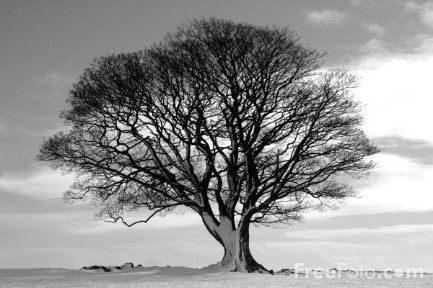 |  |
Colour And The History Of Colour
Colour Photography was explored beginning in the mid-19th century. Early experiments in color required extremely long exposures (hours or days for camera images) and could not "fix" the photograph to prevent the color from quickly fading when exposed to white light.
The first permanent color photograph was taken in 1861 using the three-color-separation principle first published by physicist James Clerk Maxwell in 1855. Maxwell's idea was to take three separate black-and-white photographs through red, green and blue filters. This provides the photographer with the three basic channels required to recreate a color image. Transparent prints of the images could be projected through similar color filters and superimposed on the projection screen, an addictive Method of color reproduction. A color print on paper could be produced by superimposing carbons prints of the three images made in their complementary colours, a subtra ctive method of color reproduction pioneered by Louis Ducos du Hauron in the late 1860s. Russian photographer Sergei Mikhailovich Prokudin-Gorskii made extensive use of this color separation technique, employing a special camera which successively exposed the three color-filtered images on different parts of an oblong plates. Because his exposures were not simultaneous, unsteady subjects exhibited color "fringes" or, if rapidly moving through the scene, appeared as brightly colored ghosts in the resulting projected or printed images.
The development of color photography was held back by the limited sensitivity of early photographic materials, which were mostly sensitive to blue, only slightly sensitive to green and virtually insensitive to red. The discovery of dye sensitization by photochemist Hermann Vogel in 1873 suddenly made it possible to add sensitivity to green, yellow and even red. Improved color sensitizers and ongoing improvements in the overall sensitivity of emulsions steadily reduced the once-prohibitive long exposure times required for color, bringing it ever closer to commercial viability.
Autochrome, the first commercially successful color process, was introduced by the Lumière brothers in 1907. Autochrome plates incorporated a mosaic color filter layer made of dyed grains ofpotato starch, which allowed the three color components to be recorded as adjacent microscopic image fragments. After an Autochrome plate was reversal processed to produce a positive transparency, the starch grains served to illuminate each fragment with the correct color and the tiny colored points blended together in the eye, synthesizing the color of the subject by the addictive method. Autochrome plates were one of several varieties of additive color screen plates and films marketed between the 1890s and the 1950s.
Kodachrome, the first modern "integral tripack" (or "monopack") color film, was introduced by Kodak in 1935. It captured the three color components in a multilayer emulsion. One layer was sensitized to record the red-dominated part of thespectrum, another layer recorded only the green part and a third recorded only the blue. Without special film processing, the result would simply be three superimposed black-and-white images, but complementary cyan, magenta, and yellow dye images were created in those layers by adding color couplers during a complex processing procedure. Agfa's similarly structured Agfacolor Neu was introduced in 1936. Unlike Kodachrome, the color couplers in Agfacolor Neu were incorporated into the emulsion layers during manufacture, which greatly simplified the processing. Currently available color films still employ a multilayer emulsion and the same principles, most closely resembling Agfa's product.
Instant color film, used in a special camera which yielded a unique finished color print only a minute or two after the exposure, was introduced by Polaroid in 1963.
Color photography may form images as positive transparencies, which can be used in a slide projector, or as color negatives intended for use in creating positive color enlargements on specially coated paper. The latter is now the most common form of film (non-digital) color photography owing to the introduction of automated photoprinting equipment.
Stereoscopic
Photographs, both monochrome and color, can be captured and displayed through two side-by-side images that emulate human stereoscopic vision. While known colloquially as "3-D" photography, the more accurate term is stereoscopy. Such cameras have long been realized by using film, and more recently in digital electronic methods (including cellphone cameras).
Light field photography
Digital methods of image capture and display processing have enabled the new technology of "light field photography" (also known as synthetic aperture photography). This process allows focusing at various depths of field to be selected after the photograph has been captured. As explained by Michael Faraday in 1846, the "light field" is understood as 5-dimensional, with each point in 3-d space having attributes of two more angles that define the direction of each ray passing through that point. These additional vector attributes can be captured optically through the use of microlenses at each pixel-point within the 2-dimensional image sensor. Every pixel of the final image is actually a selection from each sub-array located under each microlens, as identified by a post-image capture focus algorithm.
